

Have you ever come across IBVS in a text message, online conversation, technical article, or social media post and wondered what it means? This abbreviation can be confusing because its meaning depends on the context in which it appears. While some people may encounter it in digital communication, IBVS also has an established technical meaning in robotics and automation.
Understanding IBVS meaning can help you recognize what someone is trying to communicate and avoid misunderstandings. In everyday conversations, it does not have one widely recognized slang definition. However, in robotics, IBVS stands for Image-Based Visual Servoing, a technology that allows robots to use camera images to guide their movements. Let’s explore its different meanings, uses, examples, and technical applications.
Quick Information About IBVS
| Detail | Information |
|---|---|
| Abbreviation | IBVS |
| Full Form in Robotics | Image-Based Visual Servoing |
| Category | Technical abbreviation |
| Texting Meaning | No widely established meaning |
| Main Industry | Robotics and automation |
| Related Technology | Computer vision and image processing |
| Common Use | Robot positioning and visual control |
| Alternative Term | Image-Based Visual Servoing |
What Does IBVS Mean in Text?
When someone uses IBVS in a text message, its meaning may depend on the conversation. Unlike popular internet abbreviations such as LOL, BRB, or IDK, IBVS does not have one universally accepted meaning in everyday texting.
It may be a personal abbreviation, an inside joke, a group-specific expression, or a typing mistake. Some people also use technical abbreviations in conversations related to their studies or professional work.
If you receive IBVS in a message, consider the following:
- Conversation topic: Is the discussion about technology, relationships, studies, or something else?
- Sender’s background: Does the person work or study in robotics or engineering?
- Surrounding words: Other words in the message may help explain the abbreviation.
- Previous conversations: The sender may have introduced the abbreviation earlier.
For example, if someone sends you IBVS while discussing a robotics project, they are probably referring to Image-Based Visual Servoing. However, in a casual conversation, you should not automatically assume that it has a particular slang meaning.
How to Interpret IBVS in a Text Message
Understanding an unfamiliar abbreviation requires looking at the complete message rather than focusing on the letters alone.
Here are some practical ways to interpret IBVS:
- Read the complete sentence: The words around IBVS may provide important clues.
- Identify the conversation topic: A technical discussion may indicate a specialized meaning.
- Consider the sender: Someone studying computer science or robotics may use technical abbreviations.
- Check the platform: An abbreviation used in a professional group may have a different meaning from one used in a private chat.
- Ask for clarification: If the meaning is unclear, asking the sender is the most reliable option.
For instance, if someone writes, “We are implementing IBVS in our robot,” the robotics meaning is clear.
On the other hand, if someone simply sends “IBVS” without additional information, there may not be enough context to understand their intention.
What Does IBVS Mean in Slang?
When it comes to internet slang, IBVS does not have a widely established or universally recognized definition.
Many online abbreviations develop within particular communities. Some are popular on social media, while others are limited to private conversations, gaming groups, or specific online communities.
IBVS may appear in informal communication, but its presence does not automatically make it a recognized slang expression.
It is important to distinguish between:
- Established slang: Abbreviations with commonly understood meanings.
- Personal abbreviations: Short forms created by individuals for convenience.
- Community-specific terms: Expressions understood by members of a particular group.
- Technical acronyms: Abbreviations used in specialized industries.
Therefore, if you encounter IBVS in slang-related content, check the surrounding conversation before deciding what it means.
Is IBVS a Common Slang Abbreviation?
No, IBVS is not generally recognized as a common texting or social media abbreviation.
Popular internet abbreviations are usually easy to recognize because they appear frequently in everyday conversations. Examples include:
- LOL: Laughing Out Loud.
- BRB: Be Right Back.
- TBH: To Be Honest.
- IMO: In My Opinion.
- IDK: I Don’t Know.
- NGL: Not Gonna Lie.
IBVS does not have the same level of recognition in everyday digital communication.
However, it may be familiar to people working or studying in robotics, engineering, and computer vision. Its popularity in a specialized technical field should not be confused with its popularity as internet slang.
Background & Origin
The background of IBVS depends on the context in which the abbreviation is used.
In robotics, IBVS is the shortened form of Image-Based Visual Servoing. It belongs to the broader field of visual servoing, which focuses on using visual information to control the movement of robots.
The concept developed alongside advances in computer vision, robotics, and camera-based control systems. Engineers wanted robots to perform tasks by observing visual information rather than depending entirely on traditional positioning methods.
In everyday texting, however, there is no well-established historical origin for IBVS as a slang abbreviation. It may be used independently by different individuals or communities.
This distinction is important because a technical acronym can have a recognized definition even when its informal internet usage remains unclear.
Usage in Different Contexts
IBVS can appear in different environments, and its interpretation depends on the subject being discussed.
Here are some possible contexts:
1. Technical discussions
In engineering and robotics, IBVS usually refers to Image-Based Visual Servoing.
2. Educational conversations
Students discussing robotics, automation, or computer vision may use IBVS as a shortened technical term.
3. Professional communication
Researchers and engineers may use the abbreviation in reports, presentations, research papers, and project discussions.
4. Online conversations
In casual chats, IBVS may be a personal or group-specific abbreviation. Its intended meaning should be confirmed through context.
5. Social media
People may encounter IBVS in technical posts, educational content, or discussions about automation.
Understanding the topic of the conversation is the easiest way to identify the intended meaning.
Meanings Across Platforms
IBVS does not have a confirmed, universal platform-specific meaning across popular social media applications. Its interpretation generally depends on the people using it and the subject of their conversation.
Here is how you might encounter it across different platforms:
IBVS on Snapchat
If you see IBVS on Snapchat, do not assume it is a popular Snapchat slang term. It could be a personal abbreviation or something specific to the conversation.
IBVS on Instagram
On Instagram, IBVS may appear in comments, captions, educational posts, or technical discussions. The surrounding content can help you understand its meaning.
IBVS on TikTok
TikTok users often introduce new abbreviations and expressions. However, IBVS should not be considered an established TikTok slang term without reliable context.
IBVS on WhatsApp
On WhatsApp, someone may use IBVS in a private message or group discussion. Its meaning may depend on the relationship between the people communicating.
IBVS on Discord
In technical or gaming communities on Discord, IBVS could refer to a specialized concept, particularly when members discuss robotics or computer vision.
The important point is that IBVS does not have a verified, fixed meaning across these platforms.
Other Fields (Technical or Specialized Meanings)
Beyond casual communication, IBVS is particularly important in technical and scientific fields.
Its most established meaning is Image-Based Visual Servoing, which is used in robotics to control movements through visual information.
The concept connects several areas of technology, including:
- Robotics: Controlling robot movements using camera images.
- Computer vision: Extracting useful information from images.
- Automation: Helping machines perform tasks with visual feedback.
- Artificial intelligence: Supporting intelligent visual perception and decision-making systems.
- Industrial engineering: Improving robot positioning and object manipulation.
In technical writing, IBVS generally refers to Image-Based Visual Servoing rather than an informal internet expression.
IBVS in Robotics: Image-Based Visual Servoing
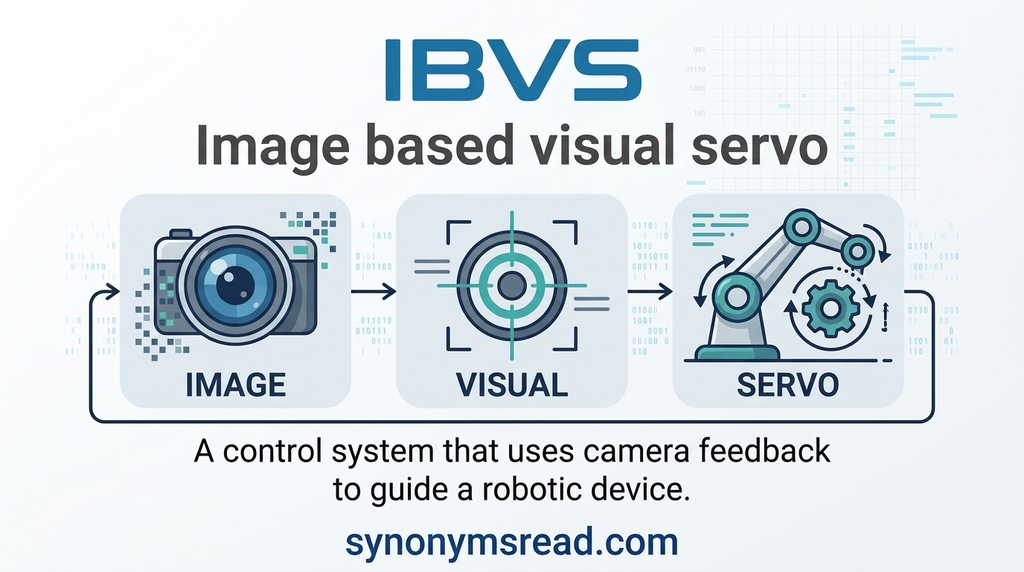
In robotics, IBVS stands for Image-Based Visual Servoing. It is a control technique that allows a robot to adjust its movements using information obtained from camera images.
In simple terms, a robot takes an image of an object, identifies important visual features, and uses that information to decide how it should move.
For example, imagine a robotic arm that needs to pick up a small object from a table. A camera captures an image of the object, and the control system analyzes its position.
If the object appears away from the desired location in the image, the robot adjusts its movement until the object reaches the required visual position.
Unlike approaches that depend directly on calculating the complete three-dimensional position of an object, IBVS uses image features as the main feedback for controlling movement.
This makes it useful in situations where visual feedback is important for accurate robot control.
How Image-Based Visual Servoing Works
Image-Based Visual Servoing works through a continuous process of capturing images, analyzing visual information, and adjusting robot movements.
The system compares the current image with a desired image or target visual position.
A simplified process includes the following steps:
1. Image Capture
A camera captures an image of the environment or target object.
2. Feature Detection
The system identifies important visual features, such as:
- Object corners.
- Edges.
- Center points.
- Specific patterns.
- Recognizable visual markers.
3. Image Comparison
The system compares the current visual features with the desired features.
4. Error Calculation
It calculates the difference between the current and desired image positions. This difference is called the image error.
5. Movement Calculation
The controller uses the image error to determine how the robot should move.
6. Robot Movement
The robot adjusts its position, direction, or orientation.
7. Continuous Feedback
The camera captures another image, and the process repeats until the desired visual position is achieved.
This continuous feedback allows the robot to correct its movements based on what the camera actually sees.
A Simple IBVS Robotics Example
Imagine a robotic arm designed to pick up a red ball from a table.
The ball is located slightly to the right of where the robot needs to reach.
Using IBVS, the process works as follows:
- The camera captures an image of the red ball.
- The vision system identifies the center of the ball.
- The controller compares the ball’s current image position with its desired image position.
- The system calculates the difference between these positions.
- The robotic arm moves toward the ball.
- The camera captures another image to check the updated position.
- The process continues until the visual error becomes sufficiently small.
<The robot can then perform the next operation, such as grasping the ball, if its complete task and grasping system support it.
This example demonstrates how IBVS uses visual feedback to guide robot movement without requiring the controller to rely exclusively on a complete three-dimensional reconstruction of the scene.
Key Components of an IBVS System
An IBVS system contains several important components that work together to control a robot through visual information.
1. Camera
The camera captures images of the environment. It provides the visual information needed by the control system.
2. Image Processing System
This component processes camera images and identifies useful visual features.
3. Feature Extraction
Feature extraction identifies important image information, such as object centers, corners, and edges.
4. Visual Controller
The controller compares the current and desired image features and calculates the required movement.
5. Robot Manipulator
The robot manipulator performs the physical movement based on the controller’s instructions.
6. Interaction Matrix
The interaction matrix, also called the image Jacobian, describes how image features change when the camera or robot moves.
7. Feedback System
The feedback system continuously checks the robot’s visual position and helps correct movement errors.
All these components work together to help the robot reach its desired visual position.
IBVS Control Loop Explained
The IBVS control loop is the repeated process through which a robot observes its environment and adjusts its movements.
It is based on feedback control, meaning the robot continuously uses new information to improve its position.
The basic control loop includes:
- Desired Image: The target image features that the robot needs to reach.
- Current Image: The image captured by the camera at the present moment.
- Error Calculation: The difference between desired and current image features.
- Control Signal: The movement instructions generated by the controller.
- Robot Action: The robot performs the calculated movement.
- New Image: The camera captures another image after the movement.
This process continues until the visual error reaches an acceptable level.
For example, if a robot needs to center an object in its camera view, the controller repeatedly adjusts the robot’s movement until the object appears near the desired image location.
The main advantage of this approach is that the robot can correct its movement using real-time visual feedback.
IBVS vs PBVS: What’s the Difference?
IBVS and PBVS are two important approaches to visual servoing in robotics. Both use camera information to control robot movements, but they process visual information differently.
IBVS stands for Image-Based Visual Servoing, while PBVS stands for Position-Based Visual Servoing.
| Feature | IBVS | PBVS |
|---|---|---|
| Full Form | Image-Based Visual Servoing | Position-Based Visual Servoing |
| Main Information | Image features | Estimated 3D pose |
| Working Method | Controls image-space error | Controls position and orientation error |
| 3D Reconstruction | Not always required | Generally required |
| Camera Data | Direct image measurements | Reconstructed spatial information |
| Main Focus | Desired image position | Desired 3D position and orientation |
| Challenges | Image-space behavior and feature visibility | Pose estimation and calibration errors |
IBVS directly controls the difference between current and desired image features.
PBVS estimates the object’s three-dimensional position and orientation before calculating the required movement.
Neither method is always better than the other. The best choice depends on the task, camera setup, environment, and control requirements.
Advantages of Image-Based Visual Servoing
Image-Based Visual Servoing offers several advantages in robotic applications.
Here are some of its main benefits:
1. Direct Visual Feedback
IBVS uses camera images to monitor the robot’s movement and make corrections.
2. Reduced Dependence on Complete 3D Reconstruction
The controller can operate using image features without always requiring a complete three-dimensional reconstruction of the environment.
3. Adaptability
The system can adjust movements based on new visual information, helping it respond to changes in the observed scene.
4. Useful for Accurate Alignment
IBVS can help robots align objects or tools with desired image positions.
5. Continuous Error Correction
The feedback loop allows the robot to correct visual positioning errors during movement.
6. Practical in Camera-Based Automation
It can support applications where cameras are already used to observe objects and guide robotic operations.
These advantages make IBVS an important technique in modern robotic control.
Limitations of IBVS
Although IBVS offers several benefits, it also has limitations that engineers must consider.
Understanding these challenges helps developers design more reliable robotic systems.
1. Image Feature Visibility
The system needs to identify and track useful image features. If an object becomes hidden or moves outside the camera’s field of view, control may become difficult.
2. Camera Quality
Poor lighting, blurry images, reflections, and low-resolution cameras can affect feature detection.
3. Complex Movement
Some movements may be difficult to control because changes in camera position do not always produce simple or predictable changes in image features.
4. Local Control Problems
IBVS may encounter local minima or undesirable configurations where the visual error does not guide the robot toward the intended solution.
5. Camera Calibration
Although IBVS can reduce dependence on complete 3D reconstruction, camera parameters and system calibration can still affect performance.
6. Computational Requirements
Real-time image processing and continuous feedback require suitable computing resources.
Engineers must consider these limitations when selecting IBVS for a particular application.
Common Applications of IBVS
IBVS has several applications in robotics and automation, especially when robots need to use camera information to guide their movements.
Some common application areas include:
- Robotic Manipulation: Helping robotic arms position themselves relative to objects.
- Industrial Automation: Supporting visual alignment during manufacturing operations.
- Object Tracking: Helping robots follow moving objects using camera feedback.
- Medical Robotics: Supporting camera-guided positioning in specialized robotic systems.
- Autonomous Systems: Helping robots adjust their movements based on visual observations.
- Precision Assembly: Assisting robots in aligning components during assembly tasks.
- Robot Navigation: Supporting visual control tasks where image features provide useful feedback.
The exact implementation depends on the robot, camera arrangement, environment, and application requirements.
Also Read : ONB Meaning
IBVS vs Traditional Robot Control
Traditional robot control often uses predefined positions, trajectories, and mathematical models to guide robot movements.
IBVS takes a different approach by using visual information as feedback.
Here are some important differences:
| Feature | Traditional Robot Control | IBVS |
|---|---|---|
| Main Input | Position and motion commands | Camera images |
| Feedback | Depends on the control system | Visual feedback |
| Environment Changes | May require updated commands or models | Can adjust using new images |
| Main Focus | Following planned movements | Reducing image-space error |
| Visual Information | May not be necessary | Essential |
| Applications | General robotic movement | Vision-guided movement |
Traditional control techniques remain useful for many robotic tasks.
However, IBVS can be especially helpful when a robot needs to observe an object and adjust its movement according to its visual position.
IBVS and Computer Vision
IBVS and computer vision are closely connected, but they are not the same thing.
Computer vision is a field of technology that allows computers and machines to understand information from images and videos.
It includes tasks such as:
- Object detection.
- Image recognition.
- Feature extraction.
- Object tracking.
- Image segmentation.
- Visual measurement.
IBVS uses some of these computer vision techniques to control robot movement.
For example, a computer vision system may identify the center of an object in a camera image. An IBVS controller can then use that information to calculate how the robot should move.
In simple terms, computer vision helps the robot understand what it sees, while IBVS uses visual information to guide its movement.
IBVS Mathematical Concept Explained Simply
IBVS uses mathematical relationships to understand how robot or camera movement changes the position of visual features in an image.
You do not need advanced mathematics to understand its basic idea.
The main concept is simple:
Visual Error = Desired Image Position − Current Image Position
For example, imagine that an object should appear at the center of a camera image.
- Desired horizontal position: 300 pixels.
- Current horizontal position: 350 pixels.
- Visual error: -50 pixels.
The controller uses this error to calculate the required movement.
In more advanced IBVS systems, engineers use an interaction matrix, also known as the image Jacobian, to connect changes in image features with camera velocity.
A simplified control equation is:
[
\mathbf{v}=-\lambda \mathbf{L}^{+}(\mathbf{s}-\mathbf{s}^{*})
]
Where:
- v: Camera velocity command.
- λ: Positive control gain.
- L⁺: Pseudoinverse of the interaction matrix.
- s: Current image feature vector.
- s*: Desired image feature vector.
The equation helps calculate movement that reduces the difference between current and desired image features.
The negative sign indicates that the controller moves in a direction intended to reduce the visual error.
This is a simplified mathematical representation. Real systems may use additional calculations, constraints, and control strategies.
Common IBVS Problems and Solutions
IBVS systems can experience different problems during operation. Most are related to image quality, feature tracking, camera movement, or control design.
Here are some common problems and possible solutions:
| Problem | Possible Solution |
|---|---|
| Poor image quality | Use a suitable camera and improve lighting |
| Lost visual features | Improve feature detection and tracking |
| Camera movement errors | Check camera calibration |
| Slow response | Optimize image processing and control calculations |
| Unstable movement | Adjust controller parameters |
| Object outside camera view | Improve camera positioning and movement planning |
| Incorrect feature detection | Use more reliable visual features |
Regular testing and calibration can improve the reliability of an IBVS system.
Engineers should also test different lighting conditions, object positions, and movement speeds before using the system in demanding applications.
IBVS in AI, Automation, and Modern Robotics
Modern robotics increasingly combines cameras, artificial intelligence, automation, and advanced control systems.
IBVS plays an important role in this environment because it provides a way to connect visual observations with physical robot movements.
For example, an intelligent robotic system may use computer vision or an AI-based model to identify an object. The IBVS controller can then use the detected image features to guide the robot toward the object.
Some important connections include:
Artificial Intelligence: AI-based vision models can help identify objects and extract useful visual information.
Industrial Automation: IBVS can support camera-guided positioning and alignment during manufacturing.
Autonomous Robotics: Robots can use visual feedback to adjust movements based on what their cameras observe.
Machine Learning: Learning-based methods can improve feature recognition, tracking, and certain aspects of visual control.
Smart Manufacturing: Camera-guided robots can support flexible production processes involving different objects and positions.
It is important to understand that AI and IBVS are not the same technology. AI can support visual perception, while IBVS provides a method for controlling robot movement using image information.
IBVS Case Study: Vision-Guided Robotic Assembly
Consider an industrial factory where robotic arms are used to assemble small electronic components.
The components must be positioned accurately before they can be connected. Traditional positioning methods may face challenges when component locations vary slightly between production cycles.
An IBVS-based system can help solve this problem.
Step 1: Camera Observation
A camera captures an image of the component that needs to be assembled.
Step 2: Object Detection
The vision system identifies important visual features, such as corners, edges, or reference points.
Step 3: Target Comparison
The controller compares the component’s current image position with the desired position.
Step 4: Movement Calculation
The system calculates the movement required to reduce the image-space error.
Step 5: Robotic Adjustment
The robotic arm moves according to the calculated control commands.
Step 6: Visual Verification
The camera captures another image to check whether the component has reached the desired position.
Step 7: Assembly Operation
Once the required alignment and other task conditions are satisfied, the robot can perform the assembly operation.
This example shows how IBVS can support vision-guided robotic assembly.
The actual performance depends on camera quality, object detection, robot design, control parameters, and the assembly environment.
Other Meanings of IBVS
Apart from Image-Based Visual Servoing, IBVS may appear in different contexts as a personal abbreviation, organization-specific term, or specialized expression.
However, there is no single alternative meaning that is universally accepted across everyday texting and social media.
When you encounter IBVS, consider these possibilities:
- Technical acronym: It may refer to Image-Based Visual Servoing in robotics.
- Personal abbreviation: Someone may have created a short form for a private conversation.
- Group-specific expression: A particular online community may use it with its own meaning.
- Typing mistake: It may be an incorrectly typed abbreviation.
Avoid assuming that every appearance of IBVS has the same definition.
If the context is unclear, asking the person who used it is more reliable than guessing.
How to Know Which IBVS Meaning Someone Means
Choosing the correct meaning of IBVS becomes easier when you examine the situation in which it appears.
Use these simple steps:
1. Check the Topic
If the conversation discusses robots, cameras, engineering, or automation, IBVS probably refers to Image-Based Visual Servoing.
2. Read the Complete Message
The words before and after IBVS may provide clues about its intended meaning.
3. Identify the Platform
A research discussion, educational group, or private chat may use the same abbreviation differently.
4. Consider the Sender
Someone working in robotics may use IBVS as a familiar technical term.
5. Ask Directly
If you cannot identify the intended meaning, simply ask the sender what IBVS stands for.
For example:
- “What do you mean by IBVS?”
- “Is IBVS related to robotics?”
- “Can you explain this abbreviation?”
These questions can help avoid misunderstandings.
Common Misconceptions & Mistakes
People sometimes misunderstand IBVS because they assume every abbreviation found online must have a popular slang definition.
Here are some common misconceptions:
Misconception 1: IBVS Is a Popular Texting Abbreviation
There is no strong basis for considering IBVS a widely recognized texting abbreviation.
Misconception 2: IBVS Has Only One Meaning Everywhere
Its interpretation depends on the context. Its established technical meaning is Image-Based Visual Servoing.
Misconception 3: IBVS and PBVS Are the Same
Both are visual servoing approaches, but they use different control strategies.
Misconception 4: IBVS Is Another Name for Computer Vision
Computer vision processes and interprets visual information, while IBVS uses image features to guide robot movement.
Misconception 5: IBVS Always Requires Complete 3D Reconstruction
One of the main characteristics of IBVS is that it can control movement directly using image features without always requiring complete 3D reconstruction.
Misconception 6: IBVS Is Used Only in Industrial Robots
It can also be relevant to research robotics, autonomous systems, and other camera-guided robotic applications.
Understanding these differences makes it easier to interpret IBVS correctly.
Similar Terms & Alternatives
IBVS is related to several technical concepts used in robotics, computer vision, and automation.
Understanding these terms can help you distinguish between different technologies.
Some related terms include:
- PBVS: Position-Based Visual Servoing.
- Visual Servoing: A broader approach to controlling robots using visual information.
- Computer Vision: Technology that allows machines to interpret images and videos.
- Image Processing: Techniques used to modify and analyze digital images.
- Robot Control: Methods used to manage robot movement and behavior.
- Feature Tracking: Following specific points or visual patterns across images.
Although these terms are connected, each has a different role in a robotic system.
IBVS vs Computer Vision
IBVS and computer vision are closely related, but they serve different purposes.
Computer vision focuses on extracting meaningful information from images, while IBVS uses visual features to control robot movements.
| Feature | IBVS | Computer Vision |
|---|---|---|
| Main Purpose | Control robot movement | Understand visual information |
| Input | Camera images and visual features | Images and videos |
| Output | Robot movement commands | Visual information and predictions |
| Main Application | Visual robot control | Image analysis and recognition |
| Relationship | Uses visual information | Can provide information to IBVS |
For example, computer vision can detect a moving object, while IBVS can use its image position to guide a robot toward it.
Therefore, computer vision can support IBVS, but the two terms are not interchangeable.
IBVS vs Visual Servoing
Visual Servoing is a general approach to controlling robots through visual feedback.
IBVS is one specific type of visual servoing.
The main difference is that visual servoing includes different methods, while IBVS focuses directly on image features.
Visual Servoing:
- Uses visual information to guide robot movement.
- Includes different control approaches.
- Can use image-based or position-based methods.
IBVS:
- Uses image features as the main control information.
- Calculates errors between desired and current image features.
- Adjusts robot movement using visual feedback.
In simple terms, all IBVS systems are visual servoing systems, but not all visual servoing systems use IBVS.
IBVS vs Image Processing
IBVS and image processing are connected through camera-based technology, but they perform different tasks.
Image processing focuses on analyzing and modifying digital images. IBVS uses visual information to calculate robot movements.
| Feature | IBVS | Image Processing |
|---|---|---|
| Main Purpose | Control robot movement | Analyze or modify images |
| Main Input | Image features | Digital images |
| Main Output | Control commands | Processed images or extracted information |
| Application | Robotics | Photography, medical imaging, computer vision |
| Relationship | Uses processed visual features | Can support IBVS |
For example, image processing may identify the edges of an object, while IBVS uses those edges to help guide a robotic arm.
Both technologies can work together in a camera-guided robotic system.
How to Respond to IBVS
If someone sends you IBVS in a text message, your response should depend on the conversation.
Since IBVS does not have a widely established slang definition, it is better to ask for clarification instead of assuming what the sender means.
Here are some simple responses:
If you do not understand it:
- “What does IBVS mean?”
- “Can you explain IBVS?”
- “I’m not familiar with that abbreviation.”
If the conversation is about robotics:
- “Are you talking about Image-Based Visual Servoing?”
- “Is this related to visual servoing in robotics?”
- “How does IBVS work in your project?”
If someone uses it casually:
- “What do you mean by IBVS?”
- “Is that a new abbreviation?”
A simple clarification can prevent confusion and help you understand the sender’s actual intention.
Example Sentences Using IBVS
The following examples show how IBVS may appear in different communication and technical situations.
Technical Examples:
- “Our robotics project uses IBVS to control the movement of a robotic arm.”
- “IBVS helps the robot adjust its position using camera images.”
- “We are studying the difference between IBVS and PBVS.”
- “The engineer implemented an IBVS controller for visual alignment.”
- “Image-based visual servoing is useful for camera-guided robotic tasks.”
Educational Examples:
- “I have an assignment about IBVS in robotics.”
- “Can you explain the IBVS control loop?”
- “Our professor discussed IBVS during the computer vision lecture.”
- “I need to understand the interaction matrix used in IBVS.”
Informal Conversation Examples:
- “Someone mentioned IBVS in the group chat. What does it mean?”
- “I saw IBVS in a post, but I couldn’t understand the context.”
- “Can you tell me what IBVS stands for?”
These examples demonstrate that IBVS is most clearly understood when the surrounding conversation provides enough information.
Popularity & Trends Over Time
The popularity of IBVS depends on the context in which it is used.
As an internet slang abbreviation, IBVS does not appear to have the same widespread recognition as common expressions such as LOL, BRB, and TBH.
However, its technical meaning remains relevant in robotics research and engineering discussions.
Image-Based Visual Servoing is connected to ongoing areas of technological development, including:
- Robot manipulation.
- Computer vision.
- Industrial automation.
- Autonomous robotics.
- AI-assisted visual perception.
- Camera-based control systems.
As robotics technology develops, visual feedback continues to be an important part of research and practical applications.
However, this does not mean IBVS is becoming a popular texting abbreviation. Its use in technical discussions should be considered separately from its use in everyday communication.
FAQs
IBVS does not have a widely recognized or universally accepted meaning in everyday texting. Its intended meaning depends on the conversation. In technical discussions, it commonly stands for Image-Based Visual Servoing
In robotics, IBVS meaning is Image-Based Visual Servoing. It is a control technique that uses camera images and visual features to guide robot movements.
IBVS controls robot movement using image-space features, while PBVS uses an estimated three-dimensional position and orientation to calculate movement. Both are visual servoing approaches
The main advantages of IBVS include direct visual feedback, reduced dependence on complete 3D reconstruction, continuous error correction, and useful image-based alignment capabilities.
No, IBVS is not widely recognized as a common internet slang abbreviation. Its most established meaning is related to robotics and automation.
BVS is used in robotics, industrial automation, robotic manipulation, camera-guided positioning, and research involving computer vision and visual contro
IBVS has an established technical meaning in robotics: Image-Based Visual Servoing. However, its meaning in informal conversations may vary depending on the sender and context.
Yes. Engineers, researchers, and robotics students may use IBVS in technical reports, academic papers, presentations, and discussions about visual servoing.
No established definition of IBVS is generally considered rude or offensive. However, its meaning in a private conversation depends on how the sender uses it.
There is no verified, widely accepted meaning of IBVS specifically when a girl uses it. The intended meaning depends on the conversation, so asking her directly is the best way to understand it.
IBVS does not have a recognized gender-specific meaning when used by a guy. It may be a personal abbreviation or a technical term depending on the situation
Yes. IBVS is a real technical acronym that stands for Image-Based Visual Servoing. It is used in robotics and engineering to describe a method of controlling robot movement through visual feedback.
Conclusion
Understanding IBVS meaning requires looking at the context in which the abbreviation appears. In everyday texting and social media, it does not have a widely established slang definition, so you should avoid assuming that everyone uses it with the same meaning. In technical communication, however, IBVS has a clear and recognized definition: Image-Based Visual Servoing.
In robotics, IBVS allows machines to use camera images and visual feedback to adjust their movements. It plays an important role in camera-guided positioning, robotic manipulation, and automation. Whether you encounter IBVS in a message, educational discussion, or technical article, understanding its context will help you identify its intended meaning correctly.

